Hard Water and Your Hair: What the Studies Actually Found
Why hair can feel coated and dull in hard water, what three lab studies on hard water and hair found, and what people try at home and in hotel showers.
You move to a new apartment, or check into a hotel for a week, and by the third wash your hair feels different. It's stiff at the ends and a little tacky at the roots. The shampoo barely foams, so you use more, and it still doesn't feel clean. Your conditioner seems to have stopped working.
Hard water gets blamed for this a lot. Some of that blame is earned and some of it isn't. Here is what the minerals are doing, what the small body of research actually says, and what people do about it.
What's in the water
USGS defines water hardness as the amount of dissolved calcium and magnesium in it. The water picks those minerals up as it moves through soil and rock, which is why hardness follows geology more than anything a utility does. Thames Water, which serves London and the Thames Valley, says it can't control hardness because it's a characteristic of the water at the source, and that most of the water in the South-East of England is hard.
In the U.S., USGS calls anything over 120 mg/L (as calcium carbonate) hard and anything over 180 very hard. In grains per gallon, a unit used by many softener sellers, that's roughly 7 and 10.5, using the Minnesota Department of Health's figure of 7 gpg for 120 mg/L. Your utility's annual water report may list hardness, but it is not required to.
Why hair might feel coated
One possible part of the experience is how cleansing products behave in hard water.
Calcium reacts with soap and forms soap scum. USGS points to this as one reason hands can feel filmy after washing in hard water, and says more soap or detergent may be needed for cleaning, including hair washing. Modern shampoos use different formulations, so the soap reaction alone cannot explain every person's experience with shampoo.
If hair feels coated or rough after washing, hardness may be one factor. The feel of hair also depends on the shampoo, conditioner and the hair itself; a rough feeling does not prove mineral buildup.
What the lab studies found
The research on hard water and hair is limited. These three small laboratory studies reported different results.
2013, International Journal of Trichology. Researchers took strands shed during combing from 15 volunteers, split each sample in two, and soaked one half in hard water (212.5 ppm as calcium carbonate) and the other in distilled water for 10 minutes on alternate days for 30 days. They found no significant difference in tensile strength or elasticity between the two.
2016, International Journal of Dermatology. Using the same kind of setup, the same lead researcher looked at the hair under a scanning electron microscope. The hard water samples had more calcium and magnesium deposited on them, a ruffled surface, and a slightly smaller average thickness (72.78 versus 78.14 micrometers).
2018, International Journal of Trichology. A different team collected hair from 70 men and divided each sample into three groups: untreated control, deionized water and hard water. The hard-water-treated strands had lower measured tensile strength than the deionized-water group. The authors inferred an increased risk of breakage from that result; they did not count breakage during everyday washing.
One study found no significant change in strength, one found more mineral deposition and surface changes, and one measured lower strength. All three worked with cut or shed strands in a lab. None tested whether a shower filter changes hair outcomes for people washing their own hair over time. The studies show that mineral deposition and strength changes can occur under some test conditions; they cannot predict what any one person's hair will feel like.
Why it can feel worse when you travel
At home, you adjust without noticing. You settle on a shampoo that works with your water, and your hair finds a routine.
On a trip, that routine breaks. You might go from soft water at home to a harder supply in one city and something different again two stops later. White scale on a hotel shower head can be a clue, though it cannot tell you the current hardness at that tap.
Trips often mean more washing, too. Sunscreen, pool water, long days outside. More washing in water your hair isn't used to is when a lot of people first notice the change.
What people try
None of these are fixes in a medical sense. They're what people with hard water tend to settle on, and results vary with your hair and your water.
A clarifying or chelating shampoo. These products are marketed for buildup. Follow the product label, especially its recommended frequency, and judge the result by your own hair rather than assuming hardness is the cause.
Less shampoo, better rinsing. If your lather is weak, piling on more shampoo can leave more behind. Some people get better results with a smaller amount worked in longer and a slower, more thorough rinse.
Conditioner on the ends. Stiff, tangly ends are often the first thing people notice, and a conditioner or leave-in on the lengths helps them comb out more easily.
Filtering the shower water. A shower filter treats water at one fixture. Some models include an ion-exchange stage intended to manage dissolved hardness minerals, but the effect depends on the media, capacity and water conditions. The hair studies above did not test shower filters, so they do not establish a hair benefit from using one.
Checking the water where you are
At home in the U.S., check your utility's annual water report. It may include hardness; if it does not, ask the utility. Private well owners can use a suitable test kit or a qualified lab, since wells are not covered by community water reports.
On the road, scale in a kettle or cloudy spots on glass can be clues, but they are not a measurement. For a number, ask the local water supplier or test the water at the tap.
A note from us
Water Healer is a Korean shower filter brand. Our travel set has Basic and Limescale options with replaceable cartridges. The Limescale option includes an ion-exchange component designed to help manage dissolved hardness minerals. Water conditions and use affect cartridge life. If you are travelling for a while, check the current product guidance before deciding whether to pack a spare.
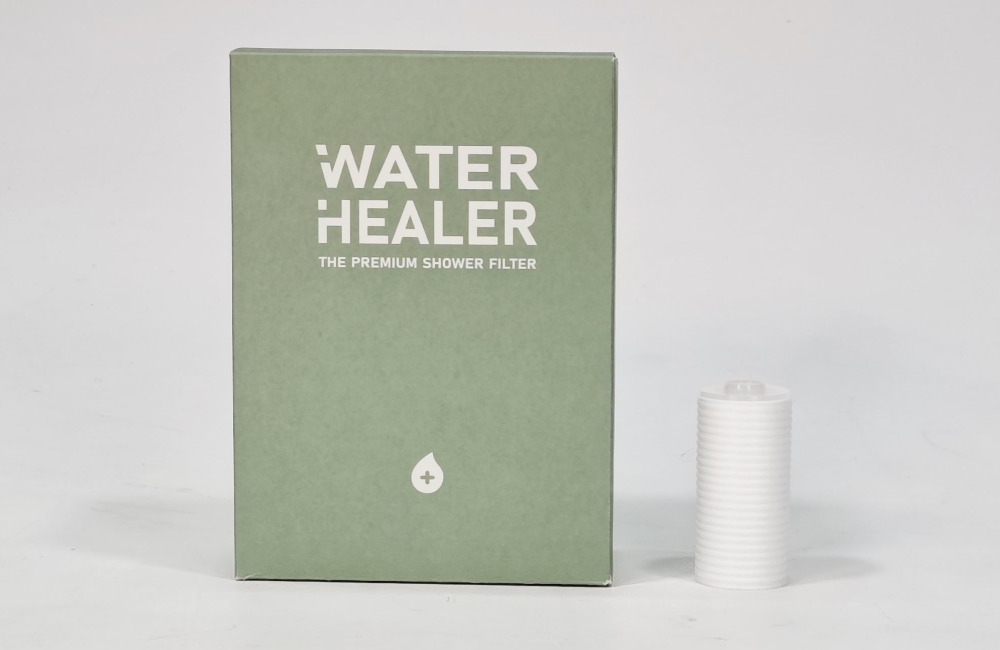
A travel-filter replacement cartridge. The photo does not identify a Basic or Limescale option.
FAQ
Does hard water damage hair?
The small laboratory studies give mixed results on hair strength. One also measured more mineral deposition on hard-water-treated strands. None followed people washing their own hair over time or tested whether a shower filter prevents damage.
Will a shower filter soften my water?
Do not assume it will. A shower filter treats water at one fixture, and any effect on hardness depends on the model's media, capacity and water conditions. A whole-house softener is a different system; the hair studies cited here do not measure either product's effect on hair.
How can I tell if my hotel's water is hard?
Low lather or scale in the bathroom can be clues, but neither gives you a hardness number or proves the cause. Ask the local water supplier for its figure, or use a suitable test kit if you need to check the water at the tap.
Sources
- USGS Water Science School, "Hardness of Water": https://www.usgs.gov/special-topics/water-science-school/science/hardness-water
- Thames Water, "Hard water": https://www.thameswater.co.uk/help/water-and-waste-help/water-quality/hard-water
- Thames Water, "About us": https://www.thameswater.co.uk/about-us
- Minnesota Department of Health, "Home Water Softening Frequently Asked Questions": https://www.health.state.mn.us/communities/environment/water/factsheet/softening.html
- U.S. EPA, "CCR Information for Consumers": https://www.epa.gov/ccr/ccr-information-consumers
- U.S. EPA, "Private Drinking Water Wells": https://www.epa.gov/privatewells
- Srinivasan G, Srinivas CR, Mathew AC, Duraiswami D. "Effects of hard water on hair." International Journal of Trichology, 2013: https://pubmed.ncbi.nlm.nih.gov/24574692/
- Srinivasan G, Chakravarthy Rangachari S. "Scanning electron microscopy of hair treated in hard water." International Journal of Dermatology, 2016: https://pubmed.ncbi.nlm.nih.gov/26711619/
- Luqman MW, Ramzan MH, Javaid U, Ali R, Shoaib M, Luqman MA. "To Evaluate and Compare Changes in Baseline Strength of Hairs after Treating them with Deionized Water and Hard Water and its Role in Hair Breakage." International Journal of Trichology, 2018: https://pubmed.ncbi.nlm.nih.gov/30034190/