How Hard Is Your Water? Check Your City's Water Report
Your utility's water report may list hardness. Learn where to look, how to read mg/L and grains, and when to ask the supplier or test your tap water.
The white crust on the shower head nozzles. The soap that won't really lather. The glass shower door that looks cloudy an hour after you wiped it. Most people start searching for fixes at this point, and most of them skip the step that costs nothing: finding out how hard their water actually is.
If you're on a community water system in the United States, your utility may already have a hardness figure. Its annual water quality report is a sensible place to look, although the report may not include hardness at all.
The report you probably threw away
EPA requires community water systems to deliver a Consumer Confidence Report to their customers. You may see it called an annual drinking water quality report instead. Utilities have to send it out by July 1 each year.
If you can't find yours, call your water supplier or use EPA's online CCR search tool. Renters can ask the supplier too. If the system serves several areas, ask which figures apply to your address.
Changes are coming, too. Under revisions EPA finalized in 2024, reports get easier to read starting in 2027, and systems serving more than 10,000 customers will have to send them twice a year instead of once.
Why hardness can be hard to find
This is where most people get stuck. The report is built around regulated contaminants. According to EPA, it covers where your water comes from, which regulated contaminants were detected, the health effects of anything found above a standard, and what the utility did about it.
Hardness isn't on that list. It doesn't appear in EPA's national primary drinking water regulations, and it isn't one of the secondary standards EPA uses for taste, odor and appearance issues either. So each utility decides whether to print it.
Some put it in a table labeled something like "additional parameters," "unregulated," or "water quality characteristics." Some skip it entirely. When you open the PDF, search for these words:
- hardness
- total hardness
- calcium
- CaCO3
If none of them turn up, call the number in the report and ask. The Minnesota Department of Health gives the same advice: if you're on a community water system, you can contact it directly for hardness information.
Reading the number
Once you find a hardness figure, check the unit. Reports may express it in milligrams per liter (mg/L) as calcium carbonate. Some use ppm. Water softener sellers and many home test kits use grains per gallon (gpg) instead.
To switch between them, a useful anchor comes from the Minnesota Department of Health, which puts 7 grains per gallon at 120 mg/L. That works out to roughly 17 mg/L per grain. So a report showing 170 mg/L is about 10 gpg, and 85 mg/L is about 5.
USGS groups hardness like this:
| Hardness (mg/L as CaCO3) | Approx. grains per gallon | USGS label |
|---|---|---|
| 0 to 60 | 0 to 3.5 | Soft |
| 61 to 120 | 3.5 to 7 | Moderately hard |
| 121 to 180 | 7 to 10.5 | Hard |
| Over 180 | Over 10.5 | Very hard |
Keep in mind that these labels aren't universal. Thames Water in England, for instance, calls anything up to 100 mg/L soft, labels 100 to 200 "slightly" or "moderately" hard, and saves plain "hard" for 200 and up. A product box that says "for hard water" may be using a different scale from the one in your report.
If your report shows a range instead of one number, ask the utility what the range covers and whether it applies to your address. A tap test can help you check the water you actually use.
What that number looks like in your bathroom
USGS describes hardness simply: it's mostly dissolved calcium and magnesium. Two things happen when that water meets a shower.
First, soap. Calcium reacts with soap and forms soap scum, which is why hard water can leave a film on your hands after washing. USGS also notes you end up needing more soap or detergent to get things clean, and it names hair specifically along with hands and laundry.
Second, heat. When hard water is heated, calcium carbonate can come out as a solid deposit. That's the scale that builds up in water heaters, and it's the same chalky crust that forms around the nozzles of a shower head. Over years, USGS says, scale inside pipes can narrow them enough to lower water pressure.
Hardness itself is generally a nuisance rather than a health risk. USGS describes the spots and film as unsightly rather than dangerous. That says nothing about any other contaminants in a particular water supply; use the report for those questions.
When the report doesn't apply to you
Two situations where the city report won't tell you much:
You're on a private well. EPA says private wells aren't regulated under the Safe Drinking Water Act, and around 15 percent of the U.S. population relies on one. There's no annual report. A home test kit or a water testing lab is how you get a number. Minnesota's health department points people to its lab accreditation program for this.
Your water is treated after it leaves the utility. Some utilities soften water before delivery, and a building may treat it further. Minnesota's health department recommends checking whether a community already softens its supply before adding a home softener. If you need the hardness at your shower, test there with a suitable kit or ask a qualified lab.
Deciding what to do with the number
Higher hardness can mean more scale, but how quickly it appears also depends on temperature, use and cleaning. The classification is a starting point, not a maintenance schedule.
For scale on a shower head, follow the fixture maker's cleaning instructions. USGS explains why acid can dissolve mineral deposits, using vinegar in a coffee maker as an example; that does not establish that a vinegar soak is suitable for every shower head or finish.
A whole-house softener is the big-ticket option. Minnesota's health department lists real tradeoffs, including added sodium, possible pipe corrosion and salt waste going down the drain, so it's worth reading their page before you buy one.
A shower filter treats water at one fixture. A model with an ion-exchange stage may be designed to manage dissolved hardness minerals, but its effect depends on the media, capacity and water conditions. Do not treat a shower filter as a whole-house softener or assume it will bring very hard water into the soft range.
A note from us
Water Healer is a Korean shower filter brand. Our travel set has Basic and Limescale options with replaceable cartridges. The Limescale option includes an ion-exchange component designed to help manage dissolved hardness minerals. Results and cartridge life vary with water quality and use, so a hardness figure can inform your choice without predicting a replacement date.
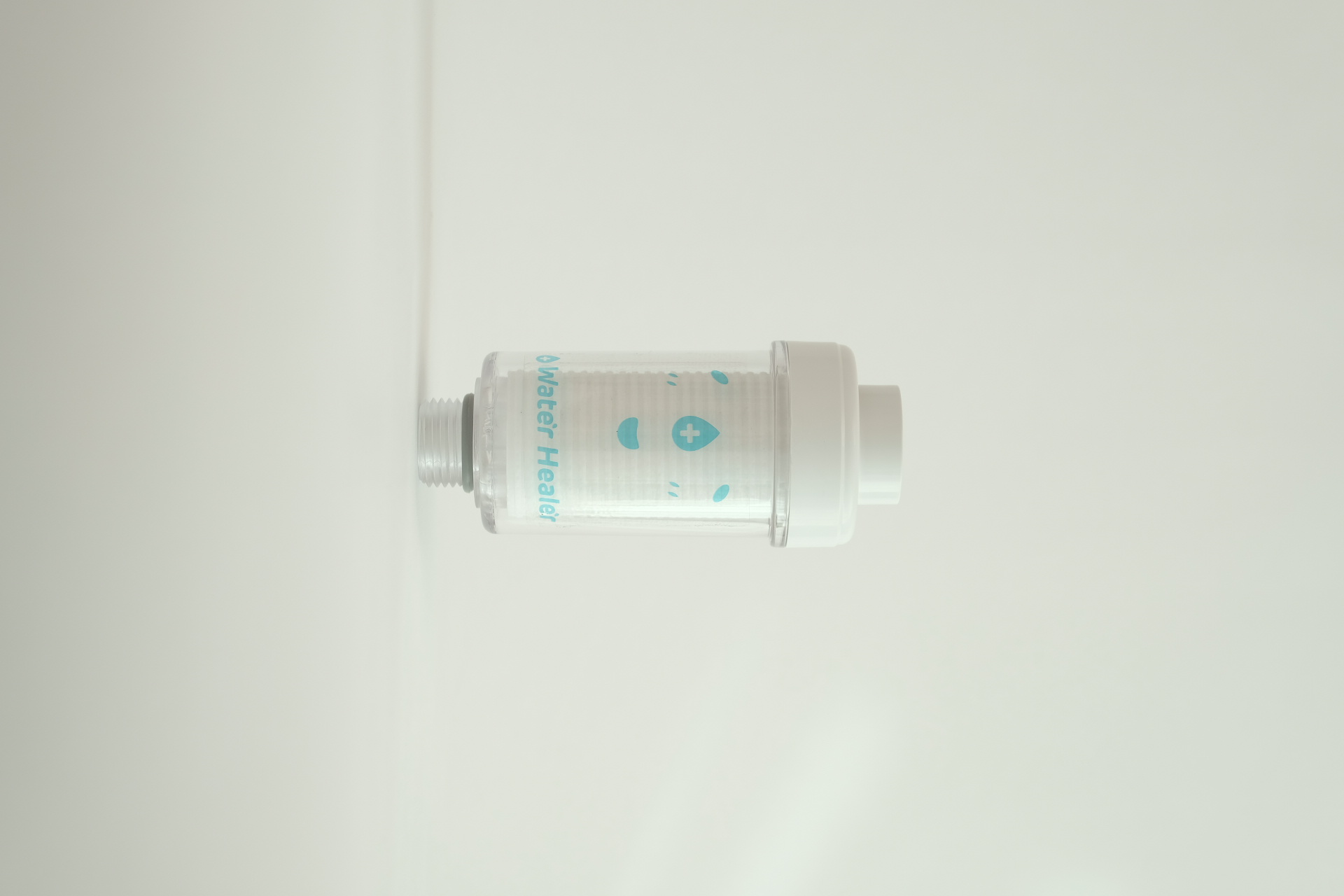
The current Water Healer travel filter, photographed from the front.
FAQ
Does my water report list hardness?
Maybe. Hardness isn't a regulated contaminant under EPA's drinking water standards, so utilities decide whether to include it. Search the report for "hardness," "calcium," or "CaCO3." If it isn't there, call the phone number listed in the report and ask.
How do I convert mg/L to grains per gallon?
Divide by about 17. The Minnesota Department of Health equates 7 grains per gallon with 120 mg/L, so 170 mg/L is roughly 10 gpg. Reports that include hardness may use mg/L or ppm, while softener sellers and test kits often use grains.
Is hard water safe to shower in?
Hardness itself is generally considered a nuisance, not a health hazard. USGS describes hard-water residue as unsightly rather than dangerous. A hardness number does not tell you whether your water meets other drinking water standards, so check the full water report for those.
Sources
- U.S. EPA, "CCR Information for Consumers": https://www.epa.gov/ccr/ccr-information-consumers
- U.S. EPA, "Consumer Confidence Report Rule Revisions": https://www.epa.gov/ccr/consumer-confidence-report-rule-revisions
- U.S. EPA, "National Primary Drinking Water Regulations": https://www.epa.gov/ground-water-and-drinking-water/national-primary-drinking-water-regulations
- U.S. EPA, "Secondary Drinking Water Standards: Guidance for Nuisance Chemicals": https://www.epa.gov/sdwa/secondary-drinking-water-standards-guidance-nuisance-chemicals
- U.S. EPA, "Private Drinking Water Wells": https://www.epa.gov/privatewells
- USGS Water Science School, "Hardness of Water": https://www.usgs.gov/special-topics/water-science-school/science/hardness-water
- Minnesota Department of Health, "Home Water Softening Frequently Asked Questions": https://www.health.state.mn.us/communities/environment/water/factsheet/softening.html
- Thames Water, "Hard water": https://www.thameswater.co.uk/help/water-and-waste-help/water-quality/hard-water